
 By Sky Linker Media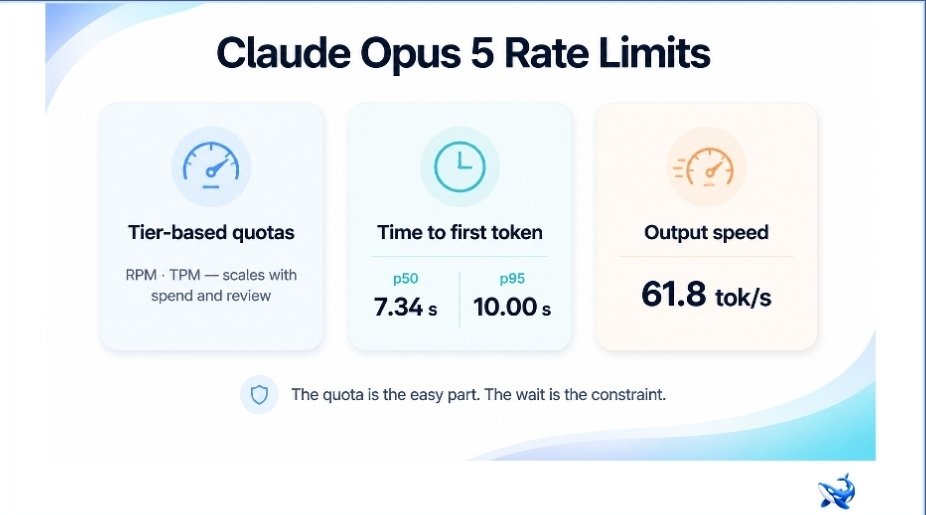
Claude Opus 5 API are the wrong thing to worry about first. Anthropic’s flagship reasoning model is served behind tier-based requests-per-minute and tokens-per-minute ceilings that climb as your spend and account review status rise, but in real production traffic the constraint that actually bites is latency, not quota. On OrcaRouter’s seven-day window, Claude Opus 5’s p50 time to first token is 7.34 seconds and its p95 is 10.00 seconds — our own telemetry, checked 2026-08-22 — and at $25 per million output tokens (our rate-card verification, 2026-08-18) every retried request is also a cost, which is why Claude Opus 5, with its live rate card and telemetry, belongs in the same conversation.
Every quota page you read makes the rate limit sound like a wall you will eventually hit: raise the tier, get reviewed, run into the ceiling, wait. Teams actually integrating a model like this spend their days on different numbers — how long until the first token appears, how long the model takes to answer, and how their retry logic behaves when forty requests land in the same second.
How Claude Opus 5 rate limits actually work
Claude Opus 5 — released July 24, 2026 (per Artificial Analysis, an independent board) — reasons over a 1,000,000-token context (independent: Artificial Analysis). The vendor structures its API access in a way that is now familiar: limits are expressed as requests per minute and tokens per minute, they are tiered, and the tier you are on scales with your spend history and a manual review. The exact tier numbers change as the program evolves, so treat any published table as a snapshot and confirm the current values on the vendor’s own docs.
Two details of that structure matter more than the headline ceilings. First, limits attach per API key and also aggregate at the org level, so what looks like a per-key ceiling can be a shared pool across your whole team. Second, the caps are a mix of hard and soft: some requests are rejected immediately, while others are allowed to overrun briefly before the enforcement catches up. Both behaviors surface to your application as the same HTTP 429, which is why so many integrations treat every 429 alike — and why they shouldn’t.
| Constraint | How it works | Where it bites |
| Tier RPM/TPM quota (vendor-reported) | Per-minute request and token ceilings that scale with spend tier and review | Bursts of concurrent calls and batch jobs |
| Key vs org scope (vendor-reported) | Limits attach per key and aggregate across the org | Keys you cannot safely share across teams |
| Hard vs soft caps (vendor-reported) | Some 429s are immediate, some follow a short overrun | Unexpected bursts right at the ceiling |
| Time to first token (OrcaRouter telemetry) | p50 7.34 s, p95 10.00 s on our seven-day window | The wait your users actually feel |
There is also a second-order effect: reasoning effort. The model exposes an effort ladder — Artificial Analysis runs it at max, xhigh, high and medium — and every thinking token a reasoning step produces counts against your output quota. Run everything at max effort and you will consume the token ceiling noticeably faster than at medium, for a quality difference you should measure on your own tasks rather than assume. Rate limits on a reasoning model are not just about how many requests you can fire; they are about how many reasoning tokens each request burns.
The limit that actually bites: latency
Here is the honest version: on OrcaRouter’s seven-day production window, checked 2026-08-22, Claude Opus 5’s p50 time to first token is 7.34 seconds and its p95 is 10.00 seconds, across 491.5M tokens of traffic in that window. For contrast, the same window shows a volume-oriented model like GPT-5.6 Luna at a p50 of 1.33 seconds. The flagship is not broken — it is thinking longer before answering. It is an output-quality model, not a latency model, and every benchmark and every production observation agrees.
Independent data points the same way. Artificial Analysis’ live board (checked 2026-08-22) scores Claude Opus 5 at 63.05 on the Intelligence Index — first of 185 models at max reasoning effort — and puts its median output speed at 61.8 tokens per second, well behind far faster models on the same board. If you want a long, careful answer, you will wait for it; if you want to stream tokens fast, this is not the model for it. The practical consequence is that your users’ perceived performance is set by that 7.34-second median wait and the ten-second p95, and the quota ceiling is rarely what interrupts them.
Why a router changes the math
Rate limits only constrain you if all your traffic is pointed at one place. Claude Opus 5 is available through the vendor’s own API and several third-party platforms, and the way you exploit that is a router. A router that load-balances across multiple keys and providers means a per-key ceiling stops being a global ceiling: one key’s throttling point is another key’s spare capacity, and a request that would have 429ed against a single account is served from the next one.
The same mechanism covers you on the org level and on the hard-soft split. If you run everything through one integration, every 429 is your problem to handle. If your requests are spread across keys and providers with automatic failover, a 429 on one path becomes an internal detail — the router retries the request on an alternative route and your application never sees the error. OrcaRouter, for example, exposes the model through a single key at a 0% markup on list price, with automatic failover between routes, so the retry logic lives once, at the routing layer, instead of in every service you write. That is the difference between a quota page being a wall and being a footnote.
Designing so a 429 is a non-event
Assume you will still hit the occasional 429 — every quota structure has one — and design so it costs you nothing.
- Retry with backoff and jitter. Exponential backoff with random jitter handles both the hard 429 and the soft overrun case far better than a fixed retry loop, which merely synchronizes all your clients onto the same collision. Respect any retry-after window the API tells you about.
- Queue and batch the bursty work. If your workload has spikes, let a queue absorb them instead of firing concurrent requests at the ceiling. Batch processing is where a slow flagship model’s latency is acceptable, because nobody is watching a spinner.
- Route by task shape. Send interactive, latency-sensitive requests to a fast model and reserve Claude Opus 5 for the long-horizon work where its quality is worth the wait. Behind a router this is a routing rule, not a second integration.
- Stream. Streaming does not shorten time to first token, but it turns the 7.34-second wait into visible progress instead of a frozen screen, which changes how the wait feels.
- Cache the stable part of your prompt. Cached input on this model costs $0.50 per million tokens against $5.00 uncached — an 80% reduction (OrcaRouter rate-card verification, 2026-08-18) — and a smaller uncached prefix means less token quota consumed on every identical request.
Independent data confirms where the real ceiling sits: Artificial Analysis’ board shows the output-speed limit at 61.8 tokens per second, which caps how long any individual generation takes no matter how high your RPM tier is. The quota will be raised when you ask; the model’s reasoning time will not.
The takeaway
If you are building something that needs a wall of concurrent Claude Opus 5 requests with sub-second answers, stop — the model will not give you that, and no rate-limit tier will fix it. The quota is the easy part: it scales with spend, it applies per key and per org, and a router that load-balances and fails over across keys and providers makes a single-key ceiling a non-issue. If you are building batch processing, long-horizon agents, or careful document analysis where seven seconds of thinking is the point, the rate limits will rarely be the first thing you notice. Confirm the current tier numbers on the vendor’s docs, budget for the 7.34-second median wait, and make sure a 429 anywhere in the stack is retried, queued, or routed around rather than surfaced to a user.
Sourcing note: tier structure, per-key versus org scoping, and hard-versus-soft caps are vendor-reported mechanisms; confirm current tier values on the vendor’s docs. Intelligence Index, rank and median output speed are independent measurements from Artificial Analysis’ live board, checked 2026-08-22. Time-to-first-token figures, token traffic and rate-card pricing are OrcaRouter’s own telemetry and verification, checked 2026-08-18 and 2026-08-22. Latency figures move with traffic and provider capacity.