
 By admin@handinhandadventures.com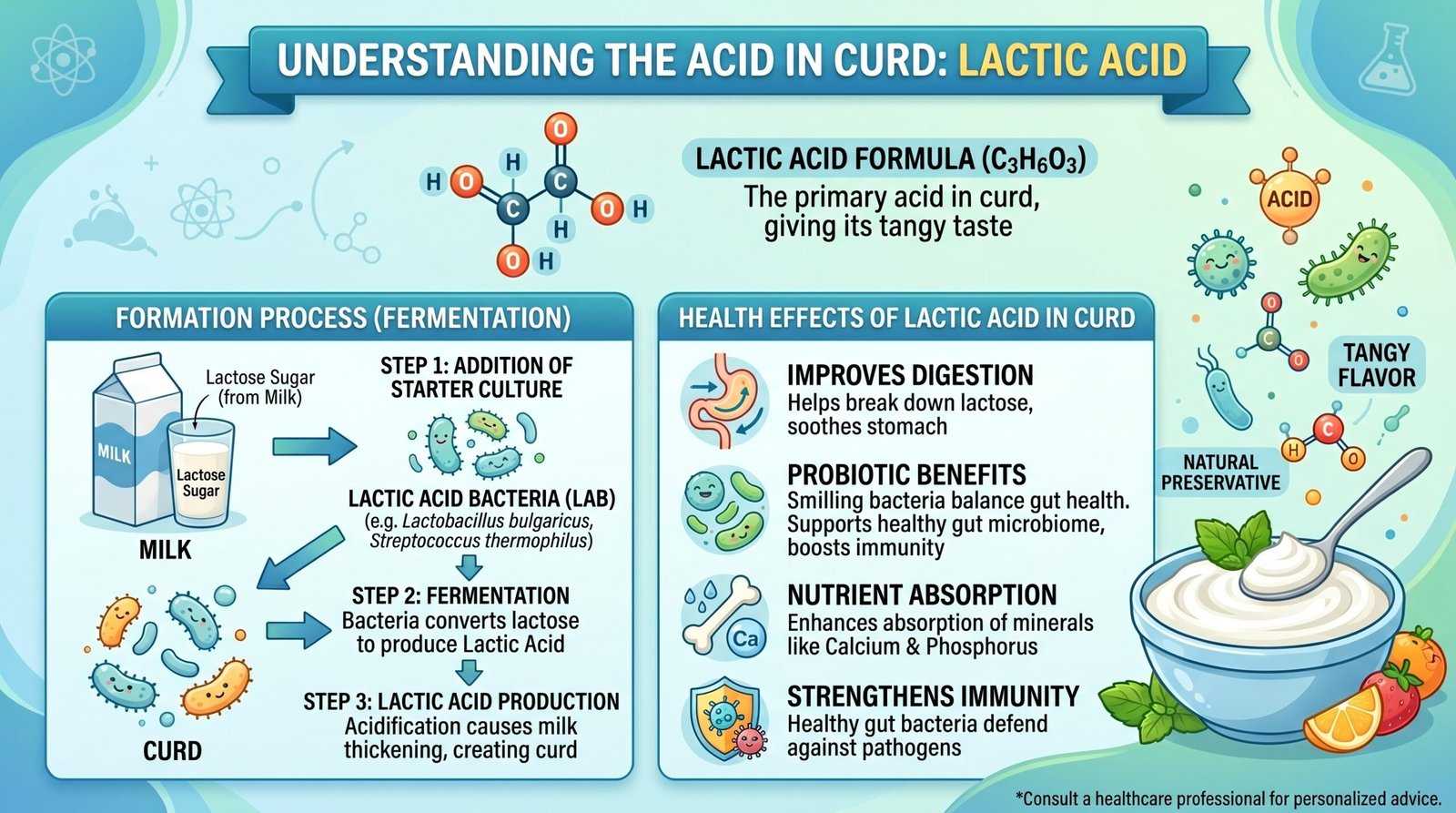
When students or curious minds search for the acid present in curd, the answer is straightforward — it’s lactic acid. But there’s alot more to this compound than a simple name. Let’s break it down.
Which Acid is Present in Curd?
Curd contains lactic acid (C₃H₆O₃). Its IUPAC name is 2-Hydroxypropanoic acid. Carl Wilhelm Scheele first isolated it back in 1780 from sour milk. The chemical formula is often written as CH₃CH(OH)COOH, showing both the hydroxyl and carboxyl groups.
How Is Lactic Acid Formed in Curd?
Bacteria from the genus Lactobacillus convert milk into curd. Here’s the simplified process:
- Lactose (milk sugar) breaks down into glucose and galactose
- These simple sugars are converted to pyruvate through glycolysis
- Pyruvate then becomes lactic acid as a byproduct — while the bacteria actually produce ATP for energy
This happens faster at room temperature (30–40°C), which is exactly why milk left out overnight turns sour. The pH of curd typically falls to around 4.0–4.5, making it noticeably tangy.
Role of Casein
As acidity rises, casein proteins in milk coagulate. That’s what gives curd its thick, semi-solid texture. Without casein, you’d just have sour liquid.
Is It Okay to Eat Curd in Acidity?
Surprisingly — yes, for most people. A 2018 study published in Nutrients showed that fermented dairy products can actually improve gut health through probiotic effects. Lactic acid bacteria aid digestion and help with calcium absorbtion. However, if you have severe acid reflux, its best to consult a doctor first.
Acid Present in Lemon, Vinegar, and Other Foods
Quick reference for exam prep:
- Lemon — Citric acid (C₆H₈O₇)
- Vinegar — Acetic acid (CH₃COOH)
- Grapes — Tartaric acid
- Tomatoes — Oxalic acid
- Ant/bee sting — Formic acid
All of these are organic acids — they contain carbon. Inorganic acids like HCl or H₂SO₄ are a diffrent category entirely.
Lactic Acid in Different Dairy Products
Not all fermented dairy is the same. Yogurt generally has higher lactic acid concentration (0.7–1.0%) compared to traditional curd (0.5–0.8%). Kefir contains even more diverse bacterial strains. Cheese varies wildly depending on aging — hard cheeses can have minimal residual lactic acid.
Uses of Lactic Acid Beyond Food
Lactic acid isn’t just about dairy. It’s used in skincare products (typically at 5–10% concentration) as a gentle exfoliant. And here’s something cool — polylactic acid (PLA), a biodegradable plastic, is derived from it. The global PLA market reached $1.2 billion in 2022 according to Grand View Research.
FAQ
Is citric acid present in curd?
No. The primary acid in curd is lactic acid. Citric acid is found in citrus fruits.
What if I eat 500g curd daily?
Moderate consumption is fine for most adults. But 500g daily may cause bloating in lactose-sensitive individuals.
Is lactic acid 10% safe?
In skincare, 10% is considered strong. Patch-test first and don’t use it daily without professional advice.
Final Thoughts
The acid in curd is lactic acid — formed through bacterial fermentation of lactose. It’s a simple fact, but understanding the chemistry behind it connects biology, nutrition, and even industrial science. Whether you’re prepping for exams or just curious about what happens in your kitchen, knowing this process gives you a deeper appreciation for something as ordinary as a bowl of curd.