
 By admin@handinhandadventures.com
Imagine walking into a high-stakes meeting with a major UAE bank or a potential private equity partner. You’ve got the growth numbers, the market share, and a solid team. But the moment they ask to see your audited financials or your internal risk reports, the room goes quiet. For many business owners in Dubai, this is the point where a promising deal starts to unravel.
The regulatory environment in the Emirates has shifted faster than most entrepreneurs anticipated. We are no longer operating in a “hands-off” tax haven. Between the introduction of Corporate Tax, the rigor of VAT inspections, and the mounting expectations of international investors, the margin for error has disappeared. Confusion often arises because the term “audit” gets thrown around loosely. You might hear you need an external audit for your trade license renewal, but your operations manager is pushing for an internal review to find out why procurement costs are leaking.
Understanding the distinction between these two isn’t just about technical definitions; it is about protecting your capital. Professional audit attestation and assurance services act as the bridge between your internal reality and the outside world’s perception of your business. This guide is designed to strip away the jargon and help you decide which tools you actually need to keep your company compliant and competitive.
Why Audits Matter More Than Ever in Dubai?
The UAE’s business landscape is currently undergoing its most significant transformation in decades. The “New Compliance Reality” means that financial transparency is no longer a luxury reserved for multi-nationals.
The New Compliance Reality
With the 2024 implementation of Corporate Tax, the Federal Tax Authority (FTA) now expects a level of record-keeping that many SMEs previously ignored. It isn’t just about filing a return; it’s about proving the numbers behind that return. VAT scrutiny has also intensified, with auditors looking closer at input tax claims and inter-company transactions. If your books are a mess, a routine check can quickly spiral into heavy penalties.
Credibility as a Competitive Advantage
Beyond the fear of fines, there is a massive growth incentive. Banks, lenders, and global partners now demand verified data before they even discuss terms. In a market as crowded as Dubai, transparency becomes a differentiator. A business that can produce a clean, independent audit report moves to the front of the line for funding.
Internal vs External Audits: The Core Difference
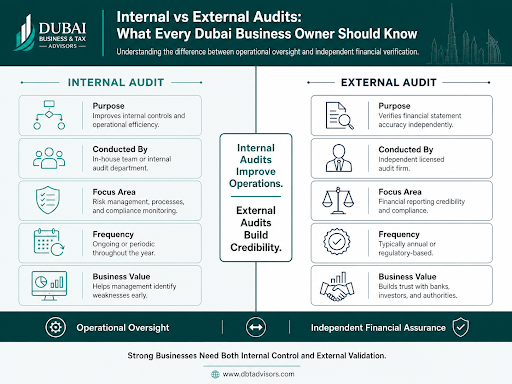
Think of your business as a high-performance vehicle. An internal audit is your own mechanic checking the engine under the hood to make sure everything runs efficiently. An external audit is the official government inspection that confirms the car is safe for the road and its documentation is legal.
Internal Audit: The Coach
An internal audit focuses on what’s happening inside your walls. It looks at your processes, your internal controls, and your operational efficiency.
- Conducted by: Either an in-house team or outsourced experts who act as an extension of your management.
- Purpose: To find risks before they become disasters. It might uncover a gap in your payroll system or a loophole in how you manage inventory in a JAFZA warehouse.
External Audit: The Referee
An external audit is purely about financial accuracy and compliance. It is an objective look at your financial statements to ensure they represent a “true and fair view” of your company’s position.
- Conducted by: An independent third party with no ties to the business.
- Purpose: To provide validation for outsiders regulators, shareholders, and banks. In most Dubai Free Zones and for Mainland companies reaching certain thresholds, this is a legal requirement.
| Feature | Internal Audit | External Audit |
| Independence | Part of the organization (or outsourced to advisors) | Must be entirely independent |
| Objective | Improve operations and manage risk | Validate financial statements |
| Frequency | Ongoing or periodic | Usually once a year |
| Legal Requirement | Generally discretionary | Often mandatory for licenses/tax |
Which Audit Does Your Business Actually Need?
One size does not fit all in the UAE. Your needs change depending on your stage of growth and your specific sector.
A Practical Decision Framework
- Startups and Early-Stage Firms: Your priority is usually basic compliance. You likely need an external audit to satisfy your Free Zone requirements or to show your first set of “real” numbers to an angel investor.
- Growing SMEs: As you hire more people and your transaction volume increases, an external audit remains mandatory, but you should start introducing periodic internal reviews. Why? Because when you grow fast, processes break. You need to ensure your “back office” is keeping up with your sales.
- Scaling Multi-Department Companies: At this level, you need both. The complexity of managing multiple licenses or departments creates “blind spots” that only a structured internal audit can catch.
- Seeking Investment or Large Loans: If you are looking for a significant injection of capital, you need a gold-standard external audit paired with a rigorous internal control environment. No serious investor in Dubai will cut a check if they suspect your internal data is unreliable.
What Happens If You Ignore the Warning Signs?
Ignoring the need for these reviews isn’t just an oversight; it’s a gamble with your trade license.
The Price of Skipping the External Audit
The most immediate consequence is legal. Many Free Zones will not renew your license without an audited financial statement. Furthermore, banks can freeze your corporate accounts if you fail to provide annual financials. Perhaps most dangerously, if the FTA suspects your Corporate Tax filings are inaccurate and you have no audited proof to back them up, you are essentially inviting a tax audit that could have been avoided.
The Cost of Neglecting Internal Audits
This is where businesses bleed money silently. Without internal oversight, fraud can go undetected for years. We’ve seen cases where weak internal controls allowed unauthorized procurement spending that cost a company more than its entire annual tax bill. Beyond fraud, you suffer from poor decision-making. If you are scaling your business based on data that hasn’t been internally verified, you are building your expansion on a foundation of sand.
How They Work Together?(The Assurance System)
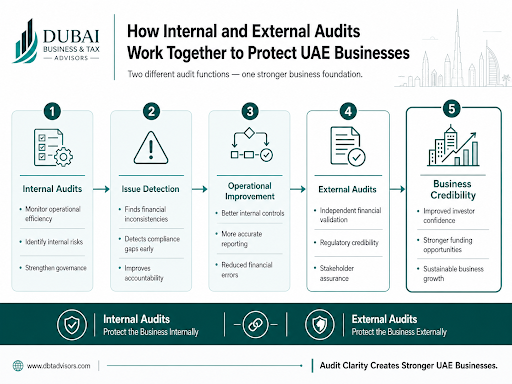
The most successful Dubai business owners don’t see these as separate chores; they see them as a combined assurance system.
Internal audits act as a continuous monitoring tool. They fix the engine while you’re driving. When the external auditor arrives at the end of the year, they find a business that is already organized and compliant. This makes the external audit faster, cheaper, and much less stressful. This synergy provides the highest level of audit attestation and assurance services, giving stakeholders absolute confidence in your trajectory.
The Audit Process: Removing the Fear
Many owners dread audits because they feel like an interrogation. In reality, they are a structured dialogue.
Internal Audit Steps
- Risk Assessment: Identifying where the business is most vulnerable (e.g., cash handling or data security).
- Process Review: Interviewing staff and testing current workflows.
- Reporting: Presenting management with a list of “leaks” and actionable ways to plug them.
External Audit Steps
- Document Review: Checking invoices, bank statements, and contracts.
- Sampling and Testing: Picking specific transactions to ensure they were recorded correctly.
- Issuance: Providing the formal audit report that you send to the authorities or your bank.
UAE-Specific Considerations
Dubai has its own quirks that you won’t find in a standard accounting textbook. For instance, if you represent a brand like Dubai Business & Tax Advisors, you know that the distinction between a DMCC Free Zone audit and a Dubai Mainland audit can involve different filing deadlines and criteria.
Furthermore, for specialized sectors such as pharmacists or musicians who require niche tax planning the internal audit must look at very specific industry risks, like PRS royalties or locum tax relief structures. If you are an AI or tech company, your audit needs to focus heavily on R&D tax credits and intellectual property valuation, ensuring you aren’t leaving money on the table.
Common Misconceptions About Audits
- Internal audit is only for big corporations.False. A small company with five employees can be ruined by one bad process or one dishonest hire.
- External auditors will find all the fraud.Not necessarily. External auditors look for material errors in the financial statements. They might miss a small, ongoing internal theft that a dedicated internal review would catch.
- Both audits are the same thing.As we’ve seen, one looks at the “How” (Internal) and the other looks at the “What” (External).
- Audits are an expense to be minimized.This is the most dangerous myth. An audit is an investment in your company’s exit value and its ability to survive a crisis.
Understanding Audit, Attestation, and Assurance
When you are looking for professional help, you will see these three words grouped together. It’s important to know the “levels” of confidence they provide:
- Audit: The highest level. It involves deep testing and a formal opinion.
- Attestation: This is a validation of a specific point. For example, a bank might ask for an attestation of your current debt levels rather than a full business audit.
- Assurance: This is the broad umbrella. It refers to any professional service that improves the quality of information for decision-makers.
Utilizing audit attestation and assurance services effectively means knowing when you need a “full physical” for the business and when you just need a “blood test” for a specific issue.
Frequently Asked Questions
What is the fundamental difference between an internal and external audit?
An internal audit is conducted by your own team to review operational processes, risk management, and internal financial controls on an ongoing basis. An external audit is carried out by an independent licensed firm producing a formal, legally recognised opinion on your financial statements. Internal audits focus on improving how your business operates from the inside, while external audits build credibility with regulators, banks, and investors. Both serve distinct but equally important purposes in maintaining a financially healthy and well-governed business.
Are internal or external audits legally required for businesses in the UAE?
External audits are legally required for most UAE businesses; free zone companies must submit audited financials for annual license renewal and mainland businesses must comply under UAE Corporate Tax regulations. Internal audits are not explicitly mandated by law but are strongly recommended as a governance best practice for growing businesses. Failing to meet external audit requirements can result in license suspension, regulatory penalties, and damaged banking relationships. Combining both types gives your business the strongest possible financial governance framework.
How does an internal audit improve day-to-day business operations in Dubai?
Internal audits examine the efficiency of your operational processes, strength of internal controls, and effectiveness of your risk management framework. They identify wasteful spending, compliance gaps, and potential fraud risks before they escalate into serious and costly problems. For Dubai businesses scaling rapidly, internal audits ensure controls grow alongside the business rather than lagging dangerously behind. This proactive oversight gives management the confidence to delegate and grow without losing operational control.
What does an external auditor actually examine during a UAE business audit?
An external auditor independently reviews your financial statements, accounting records, bank reconciliations, tax filings, and supporting documentation. They verify that reported figures are accurate, accounting policies comply with International Financial Reporting Standards, and your financial position is fairly represented. In the UAE context, external auditors also assess compliance with VAT regulations, Corporate Tax requirements, and free zone financial reporting obligations. The result is a formal audit report that carries significant weight with banks, investors, and government authorities.
Which type of audit is more important for a small or medium-sized business in Dubai?
For most Dubai SMEs, the external audit takes immediate priority as it is a regulatory requirement tied directly to license renewal and tax compliance. However, dismissing internal audits as something only large corporations need is a costly mistake many SME owners make. Even a basic internal audit process reviewing expenses, reconciling accounts, and assessing controls quarterly can prevent fraud and improve financial decision-making. The most financially resilient Dubai SMEs treat both types as complementary tools rather than choosing one over the other.
Conclusion:
In the modern Dubai economy, transparency is the only sustainable strategy. Think of an internal audit as your source of control.it ensures you are actually steering the ship. Think of an external audit as your source of credibility.it tells the world you are a safe harbour for their investment. Businesses that embrace both don’t just avoid penalties; they gain a massive strategic advantage in a competitive market.
That is where Dubai Business & Tax Advisors come in. From audit attestation and assurance services to VAT reconciliation, corporate tax compliance, and internal control reviews, their experienced team ensures your business is always transparent, compliant, and credible in the eyes of banks, investors, and regulators alike.
The future of business in the UAE belongs to those brave enough to be transparent. Partner with Dubai Business & Tax Advisors and prove your story with numbers that speak for themselves.